


Marketing Strategy for eLearning: Get Students, Build Trust, and Grow Sustainably

Table of Content
Subscribe To Get
WordPress Guides, Tips, and Tutorials


eLearning is crowded. There are hundreds of course platforms, coaching programs, cohort-based classes, and membership sites all fighting for the same attention. The problem is not that people do not want to learn online. They do. The problem is that most eLearning brands sound the same, look the same, and market themselves with the same tired tactics. If you want your eLearning business to grow, you need a marketing strategy that does more than push traffic to a sales page.
You need a system that builds trust, shows value early, and gives people a reason to stay engaged after they join. That is especially important for platforms built on WordPress. You already have the advantage of ownership and flexibility. The real question is how you turn that into a marketing edge. This article breaks down a practical marketing strategy for eLearning, including how communities can improve your reach, retention, and conversions. It also shows how FluentCommunity can support the whole thing as part of an eLearning platform.
How to Build a Marketing System That Actually Sells Your Course
Good eLearning marketing is not about doing more. It is about doing the right things in the right order. It starts with clarity, builds on trust, and grows through consistent communication with the right audience. From positioning your offer to creating content, nurturing leads, and building a learning environment around your course, every step should guide people toward a clear outcome.
The following strategy breaks down how to do that. It focuses on attracting the right learners, earning their trust, and creating an experience that supports both learning and long-term growth.
Start With a Clear Position
Most eLearning brands try to appeal to everyone, but that usually means they end up appealing to no one. Your first job is to clearly define who your program is for and what result it creates. A strong position answers a few simple but important questions:, who is this for, what problem does it solve, what outcome should people expect, and why your approach is different.
For example, your course might be for freelancers who want to build a consistent client pipeline, for parents who want to help their kids learn coding at home, or for marketers who need to improve their SEO skills fast. The clearer your position, the easier it becomes to create content, run ads, host webinars, and build a community around your product. If people cannot quickly understand what your eLearning product does, they will simply scroll past.
Build Your Marketing Around Trust, Not Hype

People do not buy eLearning because of flashy claims; they buy when they trust the teacher, the method, and the result. Your marketing should clearly answer a few key questions in their mind, such as do you understand my problem, can you explain it clearly, have you helped people like me before, and what will I actually get?
Trust is built through useful content, honest examples, strong teaching, visible results, community proof, and clear messaging. This is why your marketing should feel educational rather than pushy. The more value you provide before asking for the sale, the easier it becomes for people to say yes.
Use Content to Attract the Right People
Content marketing is still one of the strongest strategies for eLearning, but only when it is focused. Writing generic posts like “10 tips for success” rarely works unless they are directly tied to a specific result your course delivers. General advice attracts general attention, but specific advice attracts buyers.
A strong content mix should include how-to guides, problem-solving posts, comparison content, beginner-friendly explanations, case studies, mistake breakdowns, and behind-the-scenes teaching posts. This type of content should serve two clear purposes: bringing in the right traffic and pre-selling your method. When your content consistently shows how you think and solve problems, people are far more likely to trust your course and what you offer.
Use Email to Nurture Leads
Social media gets attention, but email turns that attention into action. For eLearning businesses, email is where you build the relationship that eventually leads to a sale. A strong email sequence should welcome new subscribers, teach something useful, tell a story, share proof, and gradually invite people into your offer. Instead of making every email a sales pitch, which quickly burns people out, you should use email to guide them through both the problem and the solution.
For example, you might start with a welcome email that sets expectations, then share a common mistake a few days later, follow it with a quick win, add a student story or case study, and finally invite them to join your program. This approach keeps the conversation natural and ongoing without feeling forced.
Create a Community That Supports the Course
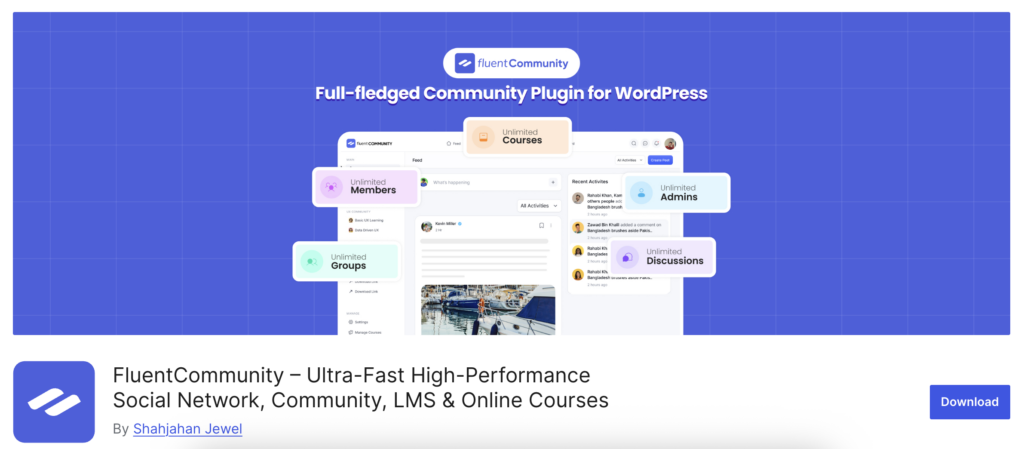
This is where many eLearning businesses leave money and retention on the table. A course on its own is just content, but a course with community becomes a true learning environment. People stay longer when they can ask questions, see others learning, and feel part of something bigger.
This is where FluentCommunity becomes especially useful. If you are building an eLearning platform on WordPress, FluentCommunity gives you a structured space to create student groups, discussion areas, onboarding sections, progress check-ins, support threads, course-related announcements, and member networking opportunities.
A community like this improves the learning experience in several ways. Students feel less alone, engagement stays higher, people ask better questions, members support each other, you receive more feedback, and you generate more visible proof of transformation.
For an eLearning business, this is not just an extra feature. It directly strengthens your marketing. When people can see real activity and learner interactions before they even buy, it builds far more trust than a polished landing page alone.
A FluentCommunity-powered learning space also helps you keep discussions inside your own WordPress site, connect community activity with your CRM and email tools, organize learners by course or level, and maintain full ownership of your audience. That creates a stronger long-term marketing foundation compared to relying on third-party social platforms.
FluentCommunity is a complete community platform designed for businesses. Download now to create and manage your community.
Use Webinars, Workshops, and Challenges
If your eLearning product is new or expensive, people may not be ready to buy from content alone. In many cases, they need a live experience first to build trust and confidence. That is why webinars, workshops, and challenges work so effectively. These formats allow you to teach in real time, show your teaching style, answer objections directly, collect leads, and gradually move people toward your course. Among these, challenges are especially powerful because they give people a quick win before the actual purchase.
For example, you might run a 5-day WordPress launch challenge, a 7-day content planning sprint, or a 3-day beginner coding bootcamp. These experiences help learners feel progress early, which naturally increases their trust in your full program. If you are using FluentCommunity, you can further enhance these live events by creating dedicated discussion spaces before and after the sessions, which keeps the conversation active and makes the entire experience feel more connected and complete.
Show Proof Early and Often

In eLearning, proof matters more than almost anything else. Students naturally want to know whether something has actually worked for others, whether the material is genuinely useful, whether they will be able to finish it, and whether it will truly help them get a real result. Because of this, proof should be shown consistently across every touchpoint, including landing pages, emails, social posts, webinars, community discussions, and sales calls.
This proof can take many forms, such as testimonials, screenshots, student wins, before-and-after results, completion stories, active community engagement, and live feedback. However, the most powerful proof is always specific. Instead of vague praise like “this course was amazing,” a statement like “I used this strategy and booked 4 clients in 2 weeks” is far more convincing because it feels real, measurable, and relatable.
Make the Buying Path Simple
People do not want to solve a puzzle before they buy, so the path from discovery to purchase should be simple and clear. Ideally, they first see your content, then join your list or community, receive consistent value, see real proof, and finally join your program. However, many eLearning businesses unintentionally add friction at every step through confusing offers, too many options, overloaded pages, and multiple calls to action. This only creates hesitation. Instead, simplicity works better.
One clear offer is stronger than three vague ones. If someone is already interested in your topic, they should immediately understand what to do next. To keep things focused, you only need one main lead magnet, one main email sequence, one main community, and one main course offer. That is more than enough to start and grow effectively.
Keep the Learning Experience Connected to the Marketing
Your marketing should not stop at the point of sale. In fact, if the learning experience is strong, it naturally becomes part of your ongoing marketing engine. This is because students who achieve real results tend to talk about them. They share their progress, celebrate wins, leave testimonials, give referrals, and recommend the program to others. Over time, this creates powerful organic growth.
This is also where FluentCommunity becomes especially valuable for eLearning. It gives students a dedicated space to share their learning journey while they are still going through the course, making their transformation visible in real time. When potential buyers can see learners actively discussing lessons, asking questions, and posting outcomes inside a community, they get a much clearer and more authentic understanding of what the program actually feels like. This kind of living proof can often drive more signups than a traditional brochure-style sales page ever could.
Use Feedback to Improve the Offer
A good marketing strategy listens, because your students will naturally tell you where they got stuck, which lessons feel confusing, what they wish existed, and what results they want next. This feedback is extremely valuable and should be used to continuously improve your content, onboarding process, course structure, sales messaging, and overall community experience. The faster you respond to real user feedback, the stronger and more refined your offer becomes over time.
If you host your community in FluentCommunity, these conversations stay organized in one place, making it easier to identify patterns and recurring issues. This not only improves the learning experience but also makes your marketing smarter and more effective as your product evolves.
How FluentCommunity Fits Into an eLearning Platform?
If you are building an eLearning platform on WordPress, FluentCommunity can serve as the social layer that connects and strengthens the entire experience. A well-structured setup typically looks like this:
Your course content lives in WordPress, your email system handles onboarding and nurturing, your CRM tracks leads and students, and FluentCommunity hosts the student community where learners can ask questions, share progress, and support each other.
This structure turns your platform into something dynamic and alive, instead of just a static library of lessons. It creates a learning environment where people grow together, which is important because users are more likely to buy, stay engaged, and complete a course when they can see real learning happening in real time.
From a marketing perspective, FluentCommunity helps you increase trust, improve retention, generate social proof, reduce churn, and build a stronger brand around your courses. That is why it should be seen as a core part of your eLearning marketing strategy, not just another tool in your product stack.
Final Thoughts
Marketing for eLearning is not about making louder promises; it is about helping the right people clearly understand the result, trust the method, and feel confident enough to get started. In principle, the strategy stays simple: define your audience clearly, create useful and focused content, nurture relationships through email, consistently show proof, keep the buying path easy, and support learners through community.
When you build your eLearning business on WordPress, FluentCommunity provides a practical way to connect your marketing directly with the learning experience itself. This creates a strong advantage because your students become part of the story as they learn and grow. In eLearning, that ongoing story is often what ultimately drives the sale.

Prema Anjum
My full name is Anzuman Ara Chowdhury. But people know me as Prema Anjum. I’m a Digital Marketer by profession, a WordPress community contributor, and a travel enthusiast by heart.
![SEO Title: 5 Best Community Portal Software [WordPress + SaaS Options]](https://fluentcommunity.co/wp-content/uploads/2026/10/community-portal-software-featured-1-1024x536.webp)
Add your first comment to this post