

WordPress vs SaaS Community Platforms: Which One Should You Choose in 2026?

Table of Content
Subscribe To Get
WordPress Guides, Tips, and Tutorials


Building an online community is no longer optional. It’s a strategic move for any modern business. A strong community helps you build deeper relationships, increase customer loyalty, and create long-term value that goes beyond one-time sales. But here’s where many people get stuck. Should you build your community on WordPress, or go with a SaaS (Software-as-a-Service) platform?
If you’ve started researching, you’ve likely seen options like WordPress, Circle, Mighty Networks, or Skool. On the surface, they all seem to offer the same promise: a simple way to create and grow your community.
However, once you look closer, the differences become clear. These platforms vary significantly in terms of control, customization, cost, and scalability. What works for a small creator may not work for a growing business.
In this guide, we’ll break everything down in simple, beginner-friendly terms so you can confidently choose the platform that fits your goals.
WordPress vs SaaS Community Platforms (2026)
| Feature | WordPress Community | SaaS Community Platforms (Circle, Mighty Networks, Skool, etc.) | Winner |
| Ownership & Control | Full ownership of website, users, content, and data | Platform controls infrastructure, policies, and access | WordPress |
| Setup & Ease of Use | Limited customization, fixed layouts, and features | Plug-and-play, no technical setup needed | SaaS |
| Customization & Flexibility | Fully customizable with themes and plugins | Built-in monetization is limited and platform-dependent | WordPress |
| Cost Structure | Low hosting cost + affordable plugins, no heavy recurring fees | Monthly subscription ($30–$100+), grows with usage | WordPress (long-term) |
| Scalability | No user limits, scales with hosting and ecosystem | Pricing increases with growth, possible feature limits | WordPress |
| Monetization Options | Full control: memberships, LMS, payments, CRM integrations | Limited integrations within the platform ecosystem | WordPress |
| SEO & Traffic Growth | Full SEO control, strong blogging + community synergy | Limited SEO control and indexing restrictions | WordPress |
| Data Ownership & Privacy | Full control and ownership of all user data | Data stored on external servers under platform rules | WordPress |
| Integrations | Works with thousands of WordPress plugins (CRM, LMS, etc.) | Limited integrations within platform ecosystem | WordPress |
| Best For | Course creators, agencies, SaaS founders, membership sites | Beginners, small communities, testing ideas | Depends on use case |
What is a WordPress Community Platform?
A WordPress community platform means you build and manage your community directly on your own website using WordPress, along with plugins. Instead of depending on a third-party service, you have full ownership and control over everything. This includes your website, your user data, your members, and all your content.
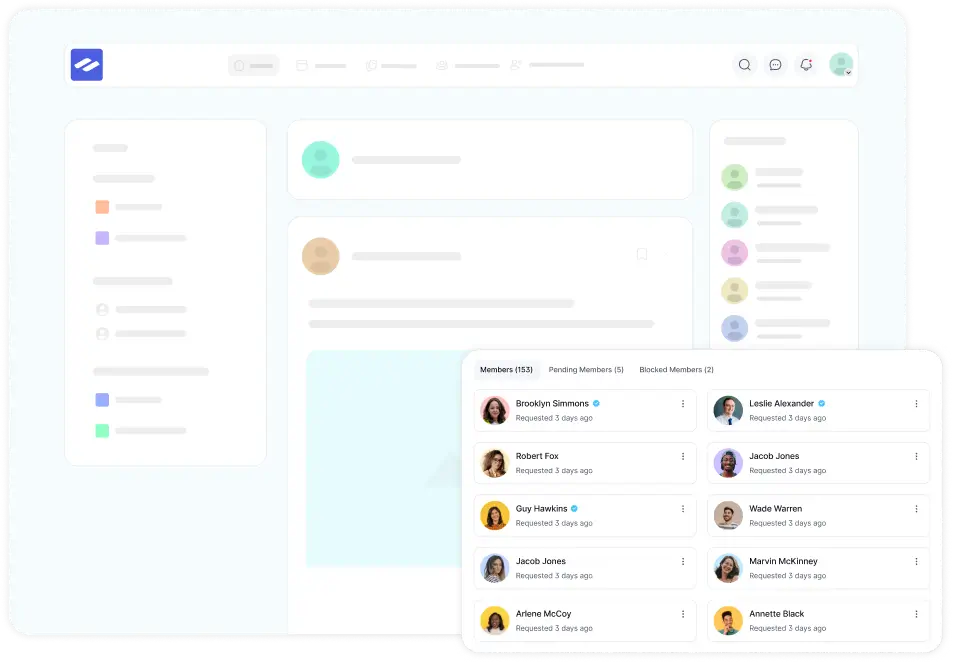
Nothing is locked inside another company’s system, which gives you more freedom and long-term stability. With tools like FluentCommunity, you can easily transform a simple WordPress site into a powerful, fully featured community platform where you can create spaces, engage members, and grow your audience in one place.
FluentCommunity is a complete community platform designed for businesses. Download now to create and manage your community.
Key Characteristics of WordPress Communities
A WordPress-based community platform gives you a high level of control and flexibility compared to hosted solutions. Here are the key points:
- Self-hosted
- Highly customizable to match your exact needs and design
- Fully owned data
- Easy integration with other WordPress plugins, etc.
In simple terms, you are building your own platform, not renting one.
What is a SaaS Community Platform?
A SaaS community platform is a hosted solution where all the technical aspects are handled for you. Instead of setting up and managing your own infrastructure, you simply sign up and start building your community on the platform. Popular tools like Circle, Mighty Networks, and Skool make it easy to launch a community without dealing with hosting, installation, or complex technical setup.
Everything from performance, updates, and security is managed by the platform itself, allowing you to focus mainly on engaging your members and growing your audience.
Key Characteristics of SaaS Communities
A SaaS community platform is designed to make setup and management simple by handling all the technical work for you. However, this convenience comes with certain limitations and trade-offs.
- Hosted by the platform provider
- Easy to set up and start using quickly
- Limited customization compared to self-hosted solutions
- Monthly or yearly subscription fees
- Operates within a platform-controlled ecosystem
In simple terms, you are renting space inside someone else’s platform.
WordPress vs SaaS: The Core Differences
Let’s compare both options side by side across the factors that actually matter when choosing a community platform, including control, cost, flexibility, scalability, customization, ownership, and long-term growth, so you can clearly understand which option fits your business best.
Ownership & Control

When it comes to ownership and control, WordPress gives you full authority over your community. You own everything, including your content, users, and data, with no platform restrictions or limitations. There is also no risk of losing access to your community since everything is hosted under your control.
On the other hand, SaaS platforms do not offer full ownership of your community. You are subject to their rules, policies, and any changes they decide to make. This includes potential risks like account suspension or unexpected pricing changes.
Winner: WordPress. This is the biggest long-term advantage because owning your community means you are not dependent on any third-party platform and have full independence over your growth and future.
Customization & Flexibility
When it comes to customization and flexibility, WordPress offers far more freedom compared to SaaS platforms. With WordPress, your community is fully customizable, and you can use thousands of plugins and themes to design and extend your platform exactly the way you want. This allows you to build almost anything, from simple communities to advanced, feature-rich ecosystems.
In contrast, SaaS platforms come with limited customization options. They typically offer fixed layouts and predefined features, which can restrict how much you can modify your community. Integration options are also often limited compared to WordPress.
Winner: WordPress. If your goal is to scale or build something truly unique, SaaS platforms may eventually become a limitation.
Ease of Use
When it comes to ease of setup and usability, WordPress requires a bit more effort in the beginning since you need to handle hosting, install plugins, and configure your site. There is also a slight learning curve involved, especially if you are new to WordPress.
At the same time, SaaS platforms offer a plug-and-play experience where everything is already set up for you. You don’t need any technical knowledge to get started, making it much faster and simpler to launch your community.
Winner: SaaS. If your priority is to launch quickly with zero setup hassle, SaaS platforms are the easier choice.
Cost
When it comes to cost, WordPress is generally more budget-friendly in the long run. With WordPress, your main expense is hosting, which is usually a low monthly cost, and many plugins are either one-time payments or very affordable. This means there are no heavy recurring fees, making it easier to control your expenses over time.
On the contrary, SaaS platforms typically charge a monthly subscription, often ranging from $30 to $100 or more, depending on the plan. As you grow and need more advanced features, additional costs can quickly add up, making it more expensive over time.
Winner: WordPress (long-term). While SaaS may look cheaper at the beginning, it often becomes significantly more costly as your community scales.
Scalability
When it comes to scalability, WordPress offers much more long-term flexibility compared to SaaS platforms. With WordPress, your community can scale based on your hosting setup, and there are no built-in limits on the number of users or features you can add. It also benefits from a fully expandable ecosystem, allowing you to extend functionality as your community grows.
In contrast, SaaS platforms usually increase pricing as your user base grows, and they may introduce feature limitations at higher scales. This can make growth more expensive and restrictive over time.
Winner: WordPress. With WordPress, you are not penalized for growing your community, which makes it a stronger choice for long-term scaling.
Monetization Options
When it comes to monetization and integrations, WordPress provides far more flexibility and control. With WordPress, you can integrate a wide range of tools such as membership systems, payment gateways, course platforms, and CRM tools, allowing you to design multiple revenue streams according to your business needs.
Whereas SaaS platforms usually come with built-in monetization features, but these are often limited in scope and flexibility. Additionally, platform fees may apply, which can reduce your overall earnings.
Winner: WordPress. With WordPress, you have full control over how you earn money and can build a monetization system that truly fits your business model.
SEO & Traffic Growth
When it comes to SEO and organic traffic growth, WordPress offers significantly more control and opportunity. With WordPress, you have full SEO control, allowing you to optimize your content, structure, and technical settings for search engines. It also lets you combine a blog and community in one platform, which helps you attract and engage users more effectively. This creates strong potential for long-term organic traffic growth from search engines like Google.
However, SaaS platforms often come with limited SEO capabilities and do not give you full control over how your content is indexed or optimized.
Winner: WordPress. This is a major advantage if your goal is to drive consistent traffic from Google and build long-term visibility.
Data Ownership & Privacy
When it comes to data control and ownership, WordPress gives you complete authority over your user information. You have full control over your data, and there is no dependency on third-party platforms, which ensures greater privacy and independence.
Then again, SaaS platforms store your data on their external servers, meaning your community is subject to their infrastructure and policies. This can limit how your data is accessed, managed, or exported.
Winner: WordPress, as it provides stronger ownership, control, and long-term security for your community data.
When Should You Choose WordPress?
You should choose WordPress if you want full control over your platform and prefer to own every part of your community, including your data and user experience. It is especially a strong choice if you are planning for long-term growth, as it offers the flexibility to scale without major restrictions.
WordPress is also ideal if you care about SEO and want to generate organic traffic from search engines, while keeping your costs under control by avoiding high recurring subscription fees. Additionally, it gives you the flexibility to integrate with a wide range of tools and services to match your business needs. Best for course creators, membership site owners, agencies, SaaS founders, and community-driven businesses.
When Should You Choose SaaS Platforms?
You should choose a SaaS platform if your main priority is to launch your community quickly without dealing with technical setup or maintenance. It is a good option if you prefer simplicity over full control and customization, as everything is already managed for you. SaaS platforms are also useful if you are still testing an idea and want to validate it before making a bigger investment.
Best for beginners, small communities, and short-term projects where ease of use and speed matter more than long-term flexibility and ownership.
The Hidden Truth Most People Don’t Talk About
Here’s something many creators realize too late: SaaS platforms are great for getting started quickly, but they can become limiting when it comes to scaling your community over time. As your audience grows, you may face higher costs, feature limitations, reduced control over your platform, and even challenges migrating your data elsewhere.
These constraints can make long-term growth more difficult than expected. That’s why many creators eventually decide to move away from platforms like Circle or Mighty Networks and switch to WordPress, where they can regain full control, flexibility, and ownership of their community.
Final Verdict
Both WordPress and SaaS platforms have their own strengths and can be useful depending on your stage and goals. However, if your objective is to build a serious, scalable, and profitable community in the long run, WordPress stands out as the better choice. It gives you full control over your platform, allowing you to shape everything according to your needs without restrictions. It also helps you keep costs lower over time compared to subscription-based models.
In addition, WordPress offers virtually unlimited growth potential, so your platform can expand as your community grows. On top of that, it provides stronger SEO opportunities, helping you attract consistent organic traffic and build long-term visibility.

Prema Anjum
My full name is Anzuman Ara Chowdhury. But people know me as Prema Anjum. I’m a Digital Marketer by profession, a WordPress community contributor, and a travel enthusiast by heart.




Add your first comment to this post