

How to Increase Engagement in Online Communities for 2026

Table of Content
Subscribe To Get
WordPress Guides, Tips, and Tutorials


You built the community. You set up the platform, wrote the welcome post, and invited your first members. And then, silence. If this sounds familiar, you’re not alone. Learning how to increase engagement in online communities is one of the hardest challenges every community manager faces, and it only gets harder as you scale.
Here’s the thing most people get wrong: engagement isn’t about posting more or trying harder. It’s about building the right system. One where members feel seen, rewarded, and genuinely connected to each other.
In this guide, you’ll learn exactly how to build that system. From crafting an onboarding experience that turns new sign-ups into active contributors, to re-engaging members who’ve gone quiet, to using tools like FluentCommunity to automate the heavy lifting. Every strategy here is practical, proven, and ready to implement. Let’s turn that silence into conversation.
Why Engagement in Online Communities is Harder Than It Looks?
Before diving into tactics, it helps to understand why most communities struggle. There’s a well-known principle in community management called the 90-9-1 rule. In most online communities, 90% of members are passive lurkers, 9% contribute occasionally, and just 1% drive the majority of conversations.
That means if your community has 1,000 members, only about 10 people are regularly creating the discussions everyone else reads. This is actually an enormous opportunity. If you can shift even a fraction of that 90% into occasional contributors, your community transforms overnight.
But what keeps people passive in the first place?
- They joined with vague intentions and never found a reason to participate
- They’re waiting for someone else to start the conversation
- The onboarding experience didn’t show them where to begin
- Content isn’t relevant to their specific interests or level of expertise
- There’s no social reward or recognition for contributing
Let’s fix these root causes first, and engagement follows naturally.
9 Proven Strategies to Increase Engagement in Online Communities
Most online communities don’t die from a lack of members. They die from lack of engagement. People join, look around, and leave. Not because they don’t care, but because nothing pulled them in. Changing that doesn’t require a bigger audience or a bigger budget. It requires the right strategies. Here are 9 proven ways to increase engagement in online communities, whether you’re just getting started or trying to breathe new life into a group that’s gone quiet.
Start With a Great Onboarding Experience
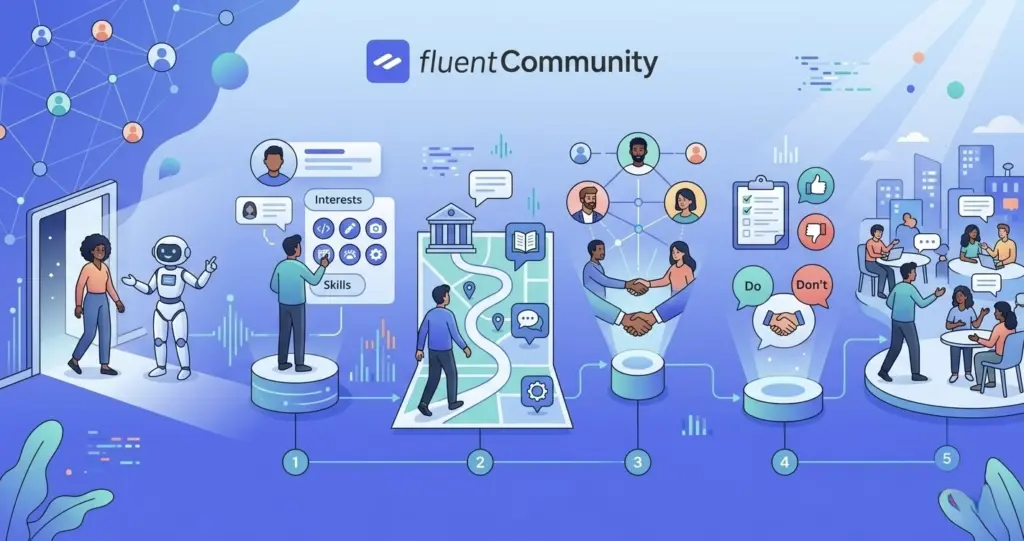
The single biggest driver of long-term engagement is what happens in the first 48 hours after someone joins. Most communities waste this window. A generic “welcome” post, a link to the community guidelines, and then nothing. Members wander around, don’t know what to do, and quietly disengage before they’ve contributed a single post.
A great onboarding experience does three things:
It makes the new member feel seen. Send a personal welcome message or, at a minimum, a well-crafted automated one via your email integration. Mention their name, acknowledge why they joined, and tell them exactly what to do next. It gives them a low-stakes first action. The hardest post anyone ever writes is their first one. Make it easy by creating a dedicated “introduce yourself” thread and actively prompting new members to post there.
Bonus: ask a specific, easy question rather than an open-ended one.
It shows them where to go. Walk new members through your community structure in the welcome sequence. What are the key spaces? Where should beginners start? What’s the one thing they should do today?
If you’re running your community on WordPress. For example, using a plugin like FluentCommunity, you can trigger automated onboarding email sequences the moment someone joins a space, so this process happens hands-free.
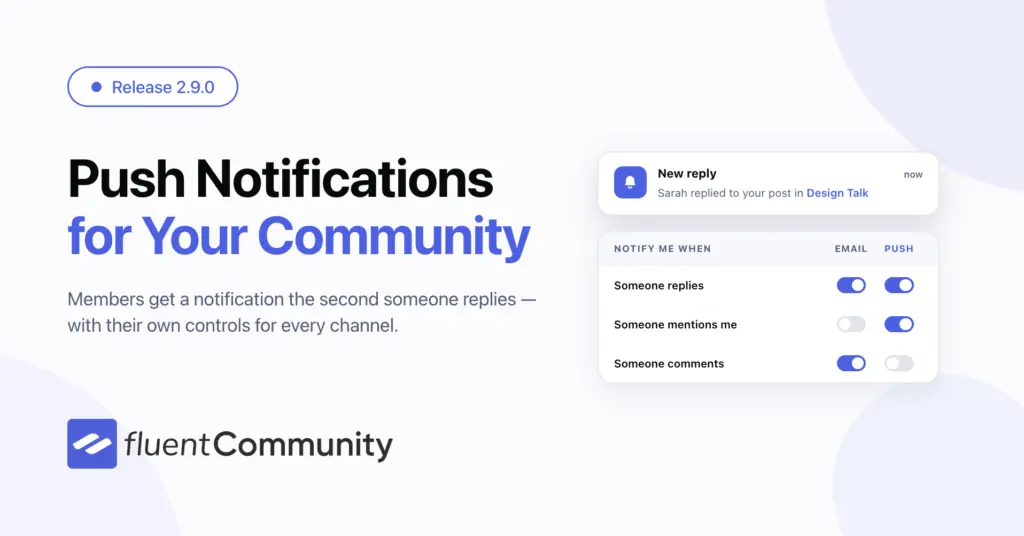
How FluentCommunity helps: FluentCommunity lets you greet new members with personalized welcome messages the moment they join. Through its deep integration with FluentCRM, you can trigger automated onboarding email sequences based on member actions. So the welcome experience runs hands-free. New members also get real-time notifications whenever someone responds to their first post, reacts to their content, or follows them, making that critical early interaction feel immediate and alive.
Post Content That Sparks Conversation, Not Just Information
One of the most common mistakes community managers make is filling their feed with announcements, updates, and informational posts. These are broadcasts; they don’t invite replies.
To increase engagement in online communities, you need to shift toward conversation-first content. Posts that are specifically designed to get a response. The best-performing post formats in active communities include:
- Opinion questions: “Hot take: [bold statement]. Agree or disagree?” These generate debate, which drives comments fast.
- Experience prompts: “What’s the most surprising thing you’ve learned about [topic] this year?” These are low-barrier because everyone has an answer.
- Polls: Quick, visual, and easy to interact with. Even lurkers will vote on a poll. Use the results to spark a follow-up discussion.
- Challenges and prompts: “Share your [result/before-and-after/work in progress] this week.” These give people a reason to post original content.
- AMA (Ask Me Anything) sessions: Invite an expert or respected community member to answer questions for a set period. These generate a burst of high-quality engagement and signal that your community has access to valuable people.
Aim for at least 60–70% of your own posts to be conversation-starters rather than announcements. Save the updates for a pinned weekly digest.
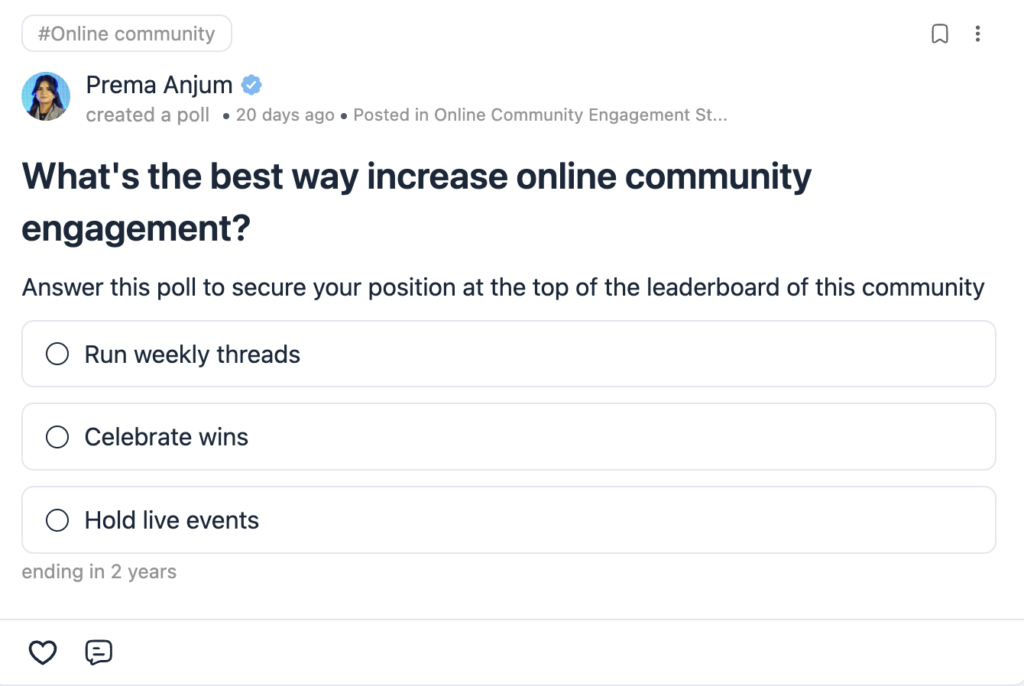
How FluentCommunity helps: FluentCommunity includes a native Polls & Surveys tool so you can create votes directly in your feed without third-party plugins. Members can also react to posts with emoji reactions, comment in threaded discussions, and enrich posts with images, videos, GIFs, and file attachments. The @mention feature with an auto-suggest box lets members tag each other in posts and comments, instantly notifying the tagged person and pulling them back into the conversation.
Build a Consistent Rhythm With Live Events
Async community activity is valuable, but nothing creates real-time energy like a live event.
Live events, Q&As, workshops, office hours, or weekly check-in calls give members a reason to show up at a specific time, which builds habit.
People who attend a live event are significantly more likely to return to the community the following week than those who only interact with async content. You don’t need to run elaborate productions. Even a 30-minute weekly “office hours” call, where members can ask questions in real time, creates a heartbeat for your community.
If you can’t do video, try text-based live threads: Announce a specific time window, and be highly responsive during that period. The sense of live interaction is what matters. To build momentum with live events:
- Schedule them consistently. Same day, same time each week, so members can plan around them
- Promote in advance. Reminder posts, emails, and pinned announcements
- Share summaries afterwards. Capture the key insights and post them for members who missed them. This gives late-joiners a reason to participate next time.
Recognise and Reward Your Most Active Members
People are more likely to contribute when their contributions are acknowledged. This sounds obvious, but most communities dramatically under-invest in member recognition. Recognition doesn’t have to be elaborate. Even small signals, such as a “like” on a post, a personal reply from the community manager, or a public shoutout in a weekly recap. Tell members that their participation matters.
More structured recognition programs to consider. Leaderboards and gamification. Points, badges, and leaderboards create a visible reward system for engagement. Platforms like FluentCommunity have built-in leaderboards and gamification features that automatically surface your most active contributors. This works especially well in communities where members are competitive or goal-oriented.
Member spotlights. Feature one active member each week or month, interview them, share their story, and celebrate their win. This creates aspiration and belonging. Contributor roles and titles. Give your top contributors a visible status, “Community Champion”, “Expert Member”, or whatever fits your culture.
People value identity, and a meaningful title signals that they’ve earned a place in the inner circle. Early access and exclusive perks. Let your most engaged members test new features first, join a private channel, or access bonus content. Reward loyalty with access, not just recognition.
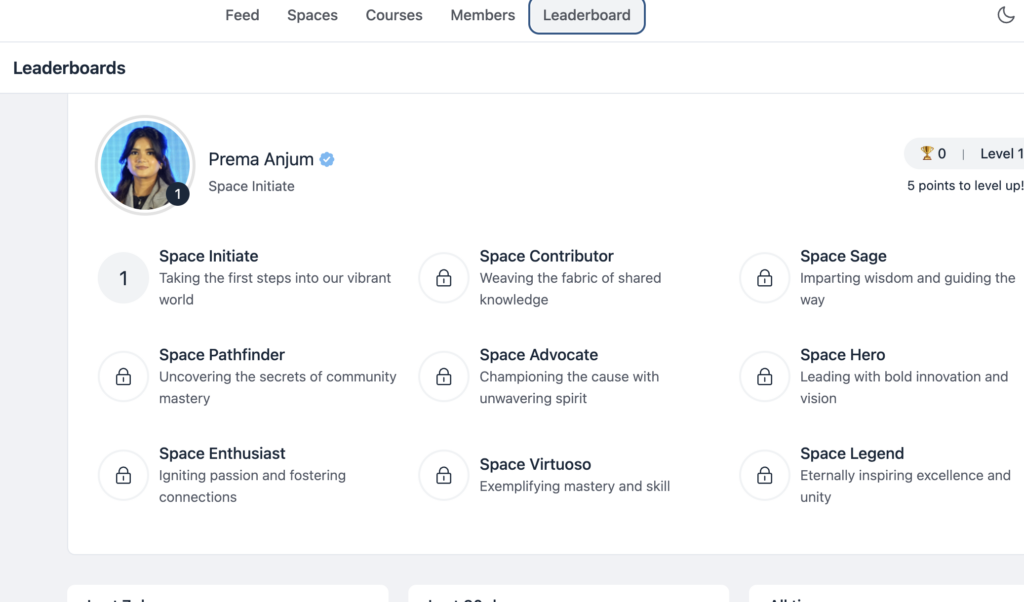
How FluentCommunity helps: FluentCommunity has a built-in Leaderboard that ranks members based on their engagement and activity. Admins can award points for posts, comments, likes, and other community actions. Members can see their ranking and movement in real time — daily, weekly, monthly, or all-time — and earn ranks and titles as they accumulate points.
When members hit milestones, badges and awards are automatically granted, and status indicators appear on their profiles. The leaderboard integrates with FluentCommunity’s notification system, so members are instantly alerted when they earn a new badge or move up in the rankings. This creates a positive feedback loop: activity leads to recognition, and recognition motivates more activity.
For community managers, the leaderboard also acts as an early-warning system. You can immediately identify your top contributors and reach out to empower them further.
Segment Your Members and Personalise the Experience
A community of 500 people is not one audience; it’s many. A beginner trying to learn the basics has completely different needs from an advanced practitioner who wants peer-level discussion. When every member gets the same content feed, most of it will feel irrelevant to most people, most of the time. That’s a fast path to disengagement.
The solution is segmentation. Divide your community into spaces or groups based on interest level, expertise, or use case, and tailor the content and conversations in each space accordingly.
There are several practical ways to segment your community. The most common is by experience level, creating a beginner’s lounge for newcomers while giving advanced practitioners their own space for deeper, peer-level discussion.
You can also segment by use case, separating coaches, developers, and content creators into dedicated spaces so each group gets conversations that actually apply to them.
If your community spans multiple products or subject areas, giving each its own focused space prevents the feed from feeling scattered and keeps members from tuning out irrelevant content.
Finally, consider segmenting by engagement level, a private, exclusive space reserved for your most active members, which not only rewards loyalty but also gives everyone else a visible goal to work toward.
Personalisation also applies to your outreach. When re-engaging inactive members, don’t send the same message to everyone. Segment by how long they’ve been inactive (30, 60, 90 days) and tailor the message and call-to-action accordingly.
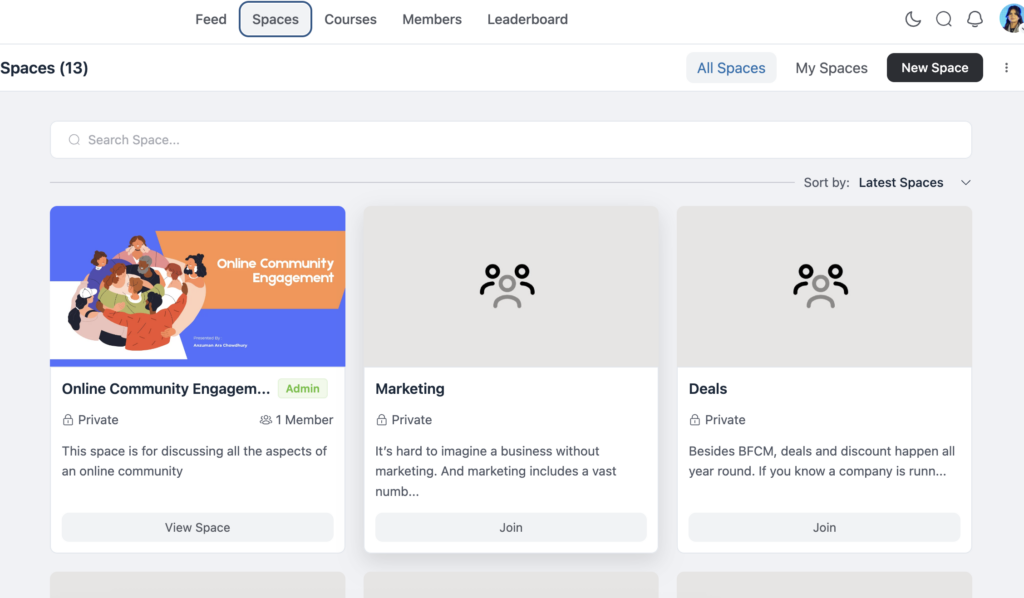
How FluentCommunity helps: FluentCommunity’s Spaces feature lets you create and manage distinct groups for focused discussions, collaboration, and networking. Each Space has its own posts, chats, and privacy rules. You can run a beginner’s lounge, an advanced practitioners’ room, use-case-specific spaces, and even exclusive VIP Spaces for your most loyal members with paid access available through Paymattic integration.
Members join the Spaces most relevant to them, so every post they see actually matters. That’s the foundation of sustainable engagement.
Activate User-Generated Content
Your own posts can only take you so far. The communities with the highest engagement are the ones where members are creating the content, not just consuming it. User-generated content (UGC) is powerful for three reasons: it’s more authentic and relatable than branded content, it scales without extra effort from you, and it creates social proof that the community is active and valuable.
How to consistently generate UGC:
- Run weekly themed threads. “Share your win of the week”, “What are you working on?”, “Post your question of the week”. Give members a repeating structure to contribute to.
- Create templates and prompts. Not everyone knows what to say. Give them a starting point.
- Celebrate member contributions publicly. When someone posts something genuinely useful, reshare it with commentary. This signals that good content gets amplified, which motivates more of it.
- Build in community rituals. Recurring traditions. Create a rhythm that members start to look forward to and participate in automatically.
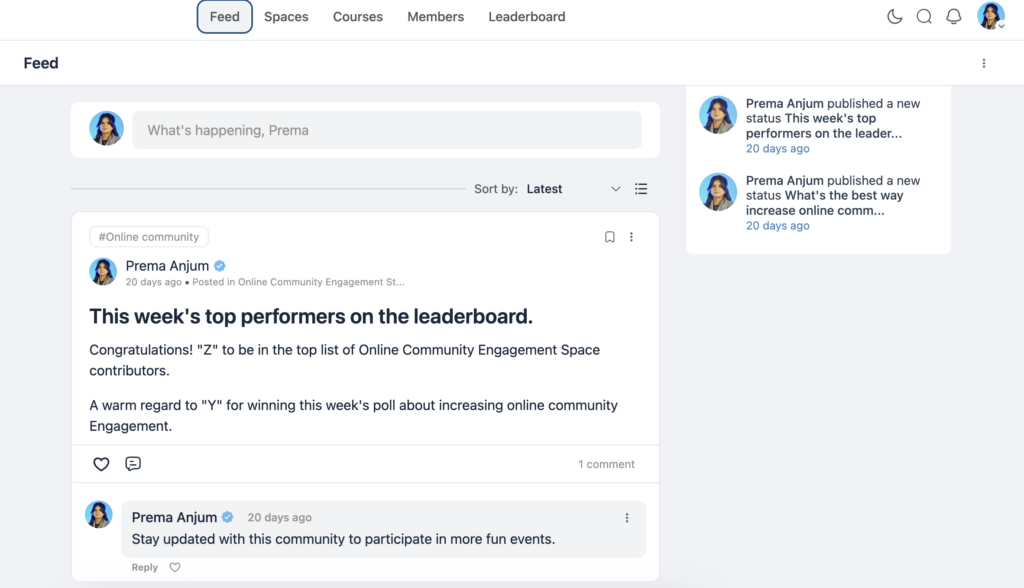
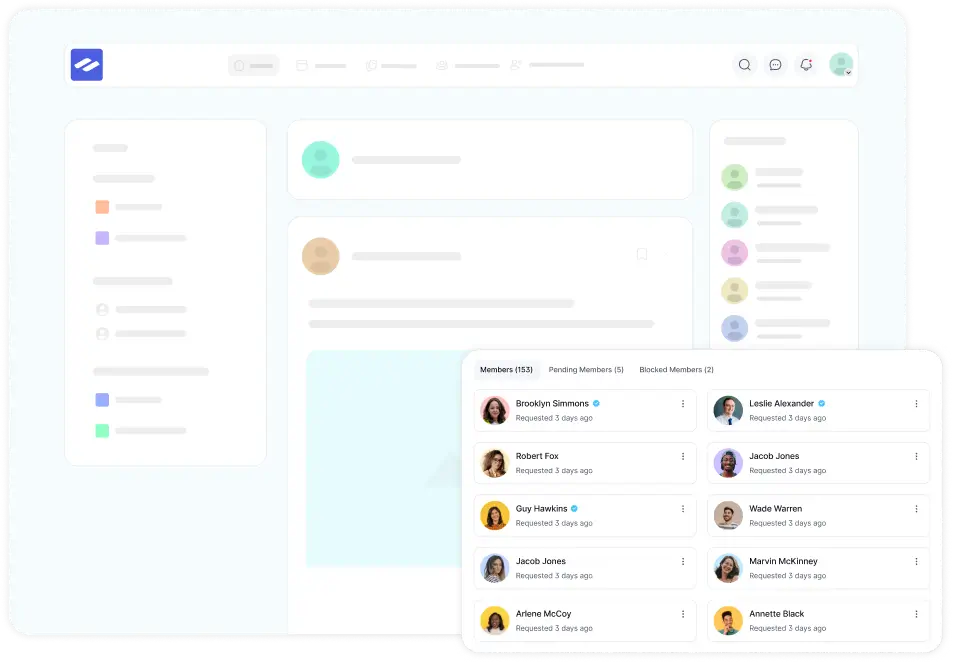
How FluentCommunity helps: FluentCommunity’s Activity Feed gives every member a real-time view of what others are posting, commenting on, and reacting to, creating a social pull to contribute. Members can bookmark posts they want to revisit, embed external content, and create rich posts with custom formatting. The searchable Member Directory makes it easy for members to find peers with shared interests and start conversations organically without you having to facilitate every connection.
Moderate Actively, and Visibly
Nothing kills community engagement faster than bad moderation. A single unconstructive argument, an unanswered spam post, or a dismissive response to a new member’s question can set the tone for the whole community, and not in a good way.
Active moderation does two things that directly increase engagement. First, it makes members feel safe. People are much more willing to share opinions, ask questions, and take social risks in a space where they know the tone is maintained and disrespect isn’t tolerated.
Second, it models the behavior you want to see. If you reply thoughtfully to every question, thank contributors, and consistently celebrate good discussions, members will mirror that behavior with each other.
Building strong moderation habits starts with one simple commitment: respond to every new member’s first post within 24 hours. That single action signals that the community is alive, welcoming, and worth participating in.
Beyond first impressions, it’s equally important to address off-topic or negative posts quickly and graciously. Not with a heavy hand, but with a redirect that keeps the tone intact. Make your community guidelines easy to find by pinning them somewhere every new member will naturally land, so expectations are clear from day one.
And as your community grows, don’t try to moderate everything yourself. Delegating responsibilities to trusted, long-standing members is one of the smartest moves you can make.
It scales your capacity without adding to your workload, and it gives your most engaged contributors a meaningful role that deepens their investment in the community’s success.
How FluentCommunity helps: FluentCommunity gives admins flexible role management and granular permissions. So you can delegate moderation to trusted members without granting full admin access.
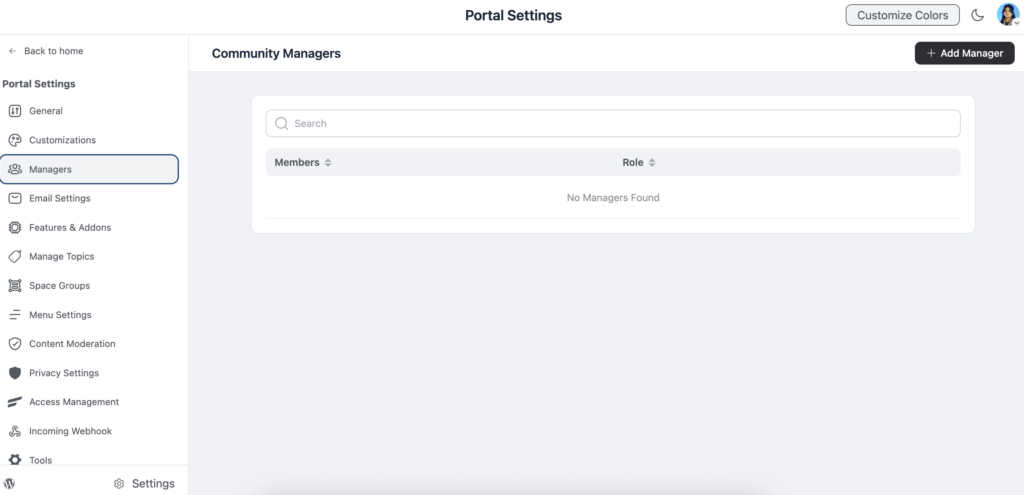
Each Space has its own privacy settings and moderation controls, meaning you can run a tightly managed private space alongside an open public one. Built-in reporting tools let members flag inappropriate messages, and the admin dashboard provides a centralized view of activity across all Spaces so nothing falls through the cracks.
Use Data to Double Down on What Works
Intuition will only take you so far. The most engaged communities are run by people who pay close attention to what the data is telling them. There are five metrics worth tracking consistently.
First, your active member rate. What percentage of members have posted, commented, or reacted in the last 30 days. Second, your post response rate. What percentage of posts receive at least one reply, because unanswered posts are one of the clearest signs of a disengaging community. Third, new member engagement, whether joiners are contributing within their first week, which tells you how well your onboarding is working. Fourth, content performance. Which post types, topics, and formats consistently generate the most interaction. And fifth, churn signals. Which members are going quiet and when they last interacted, so you can reach out before they disappear entirely.
Review these numbers monthly rather than reactively. When you spot your top-performing content, build more of it into your regular rhythm. When you find spaces with consistently low engagement, make a decision, either revive them with a targeted campaign or consolidate them so activity isn’t scattered across too many quiet corners.
If a particular post format is outperforming everything else, turn it into a repeatable content system. If one topic is driving three times more comments than anything else, that’s your audience telling you exactly what they want more of; listen to them.
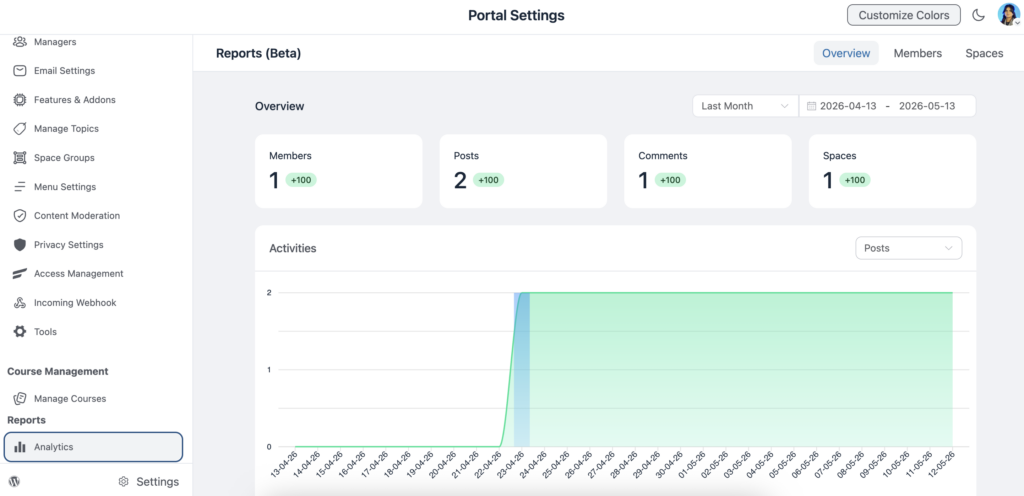
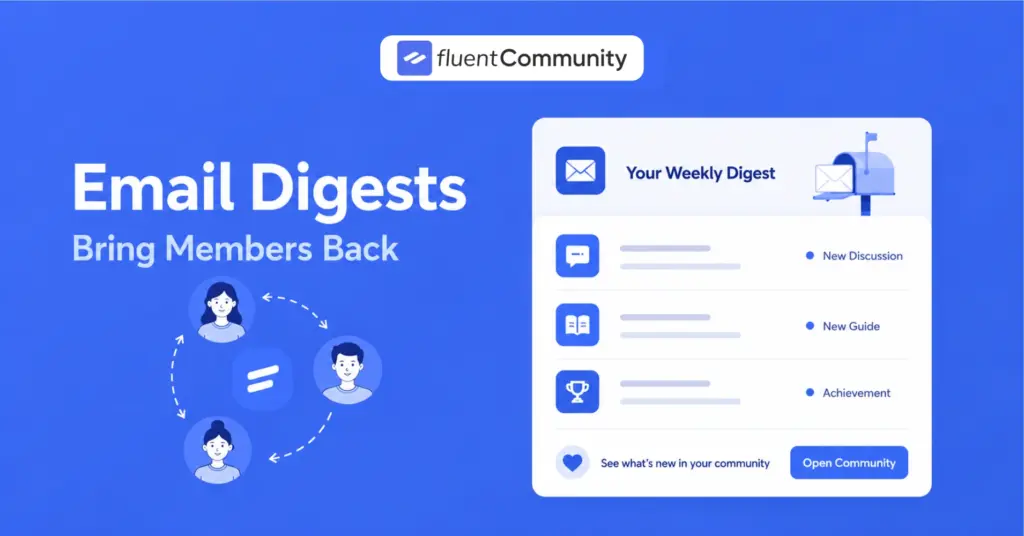
How FluentCommunity helps: FluentCommunity’s analytics dashboard gives community managers real-time insights into activity performance, including engagement reports and leaderboard data that show who’s contributing, what’s resonating, and where members are dropping off. The integration with FluentCRM lets you act on that data directly: segment inactive members by how long they’ve been quiet, and trigger targeted re-engagement email sequences automatically, all without leaving your WordPress dashboard.
Make It Easy to Invite and Grow
Organic growth is the most sustainable engine for a healthy, engaged community. Members who were personally invited by someone they trust are far more likely to engage than those who stumbled in through a cold ad. They arrive with context, a sense of belonging, and often a built-in reason to participate.
The key is to make referral behavior a natural part of your community culture rather than a one-off campaign. Start by asking your most engaged members directly: is there anyone in their network who would genuinely benefit from being here? A personal ask from a community manager carries far more weight than a generic “invite a friend” banner.
Layer in referral incentives, a month of free access, an exclusive badge, or a public shoutout for members who bring in active contributors. So there’s a visible reward for spreading the word. Then make the act of sharing as frictionless as possible: single-click invite links, easy-to-share highlights from inside the community, and regular prompts woven into your content, encouraging members to pass it along to someone who needs it.
There’s another benefit that often gets overlooked. New members who are welcomed by the person who invited them on board perform significantly better. They have a built-in guide to show them around, a familiar face in an unfamiliar space, and a social anchor that makes them far less likely to drift away in those critical first few days.
Build a Learning Layer That Keeps Members Coming Back
The communities with the best long-term retention are places where members grow. When people feel like being part of your community is actively making them better at something, they have a reason to return week after week.
This is why the most successful community platforms now blend community with structured learning: courses, lessons, progress tracking, and certificates that give members a tangible outcome.
How FluentCommunity helps: FluentCommunity has a built-in course builder fully integrated into the community experience. Instructors can create courses using the Gutenberg block editor, track student progress with a visual progress bar, and view module-level completion rates through the analytics dashboard. When a learner finishes a course, a certificate of completion is automatically awarded.
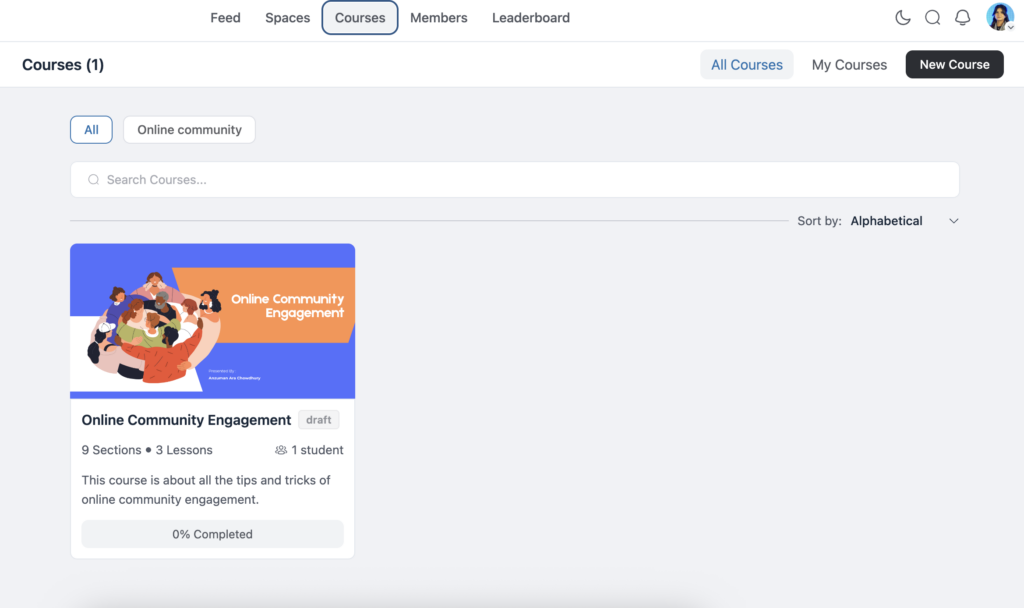
Courses live inside the community. Not on a separate platform, so lesson discussions happen right alongside the content. Students ask questions, share wins, and support each other in the same space where they’re learning. FluentCommunity also integrates with LearnDash and LifterLMS, so if you’re already running courses elsewhere, connecting them to your community is seamless.
Want to build a community that people actually use? Check out our online community engagement strategy blog post.
Putting It All Together
Learning how to increase engagement in online communities isn’t about finding one magic tactic. It’s about building a system where every touchpoint. From onboarding to content to recognition is designed to make members feel that showing up is worth their time.
The strategies in this guide work together:
- Onboarding gets new members over the first-post hurdle
- Spaces make content relevant to every member segment
- Conversation-first content drives daily activity
- Live events build habit and real-time energy
- Gamification rewards the contributors who carry your community
- Real-time chat turns acquaintances into genuine connections
- UGC programs scale your content without scaling your workload
- Moderation keeps the space safe enough for people to take social risks
- Data tells you what to do more of, and what to stop
- Learning gives members a reason to stay long-term
The communities that win aren’t the ones with the most members. They’re the ones where members feel the most connected, most recognized, and most helped.
Why FluentCommunity Is Built for Engagement?
Most WordPress community plugins give you a discussion forum and call it a day. FluentCommunity was built differently — combining community features, real-time chat, gamification, a built-in course builder, and marketing automation in a single, fast, self-hosted platform.
You own your data. You control the experience. There are no algorithm changes that can cut your reach overnight, and no per-month SaaS fees that grow against you as your community scales.
With 7,000+ active installations, a Gold Award at WPAwards 2025 in the Membership and LMS category, and a development team shipping continuous updates based on real community feedback, FluentCommunity is the platform of choice for WordPress community builders who take engagement seriously.
Ready to build a community your members actually show up for? Try FluentCommunity free today →

Prema Anjum
My full name is Anzuman Ara Chowdhury. But people know me as Prema Anjum. I’m a Digital Marketer by profession, a WordPress community contributor, and a travel enthusiast by heart.
Add your first comment to this post