

5 Best Facebook Group Alternatives in 2026

Table of Content
Subscribe To Get
WordPress Guides, Tips, and Tutorials


Facebook Groups made community building accessible for millions of businesses, creators, and educators. But the cracks are showing. Declining organic reach means your posts reach only 2-6% of your members. You don’t own your audience. Facebook can change the rules, restrict access, or shut down your group overnight. And your members see competitor ads right inside your community. If you’ve been running a Facebook Group for your brand or business and are wondering whether there’s a better home for your community, you’re not alone.
Thousands of communities are migrating to platforms that offer more control, cleaner experiences, and no algorithmic interference. This article covers the 5 best Facebook Group alternatives available today. Each option gives you more control than Facebook, a better member experience, and tools designed for building real communities, not maximizing time-on-platform for an ad business.
What Makes a Good Facebook Group Alternative?
Before jumping into the list, it’s important to understand what actually makes a platform a true Facebook Group alternative, not just another basic forum or chat tool. A real alternative gives you control, flexibility, and freedom, things Facebook simply doesn’t offer.
You own your audience
On Facebook, your community lives on borrowed land. You don’t truly own your member data, and you can’t take it with you. A good alternative ensures that your email lists, user data, and interactions belong to you. So you’re building a long-term asset, not just a temporary audience.
No competitor ads
Imagine building a community, only for your members to see ads from your competitors right next to your content. That’s exactly what happens on Facebook. A proper alternative removes this completely, giving your members a distraction-free experience focused only on your brand.
Organic reach isn’t throttled
Facebook decides who sees your posts, and often, only a small percentage of your members actually do. This forces you to pay for visibility. A strong alternative ensures your content reaches your members consistently, without needing to “boost” posts.
Monetization is yours to keep
If you’re selling memberships, courses, or exclusive content, platform fees can eat into your revenue. The best alternatives let you keep what you earn, giving you full control over how you monetize your community.
Customizable to your brand
Your community should feel like your space. Not a generic social media feed. From colors and layout to features and user experience, a good platform allows you to fully align the community with your brand identity.
Now, let’s check out the best Facebook group alternatives in 2026
FluentCommunity: Best Facebook Group Alternative for WordPress Users
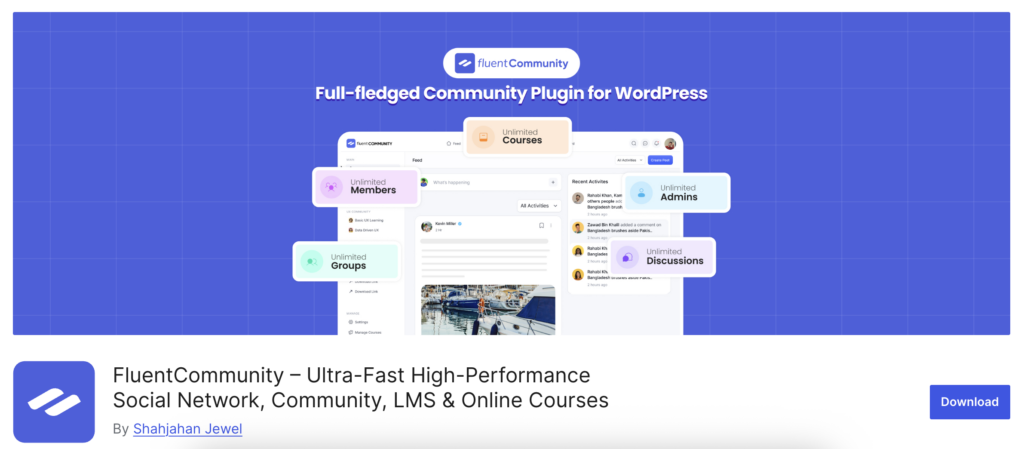
FluentCommunity is a self-hosted WordPress community plugin that lets you build a fully owned, ad-free community directly on your website. No third-party platform, no monthly SaaS fee, and no algorithmic reach throttling.
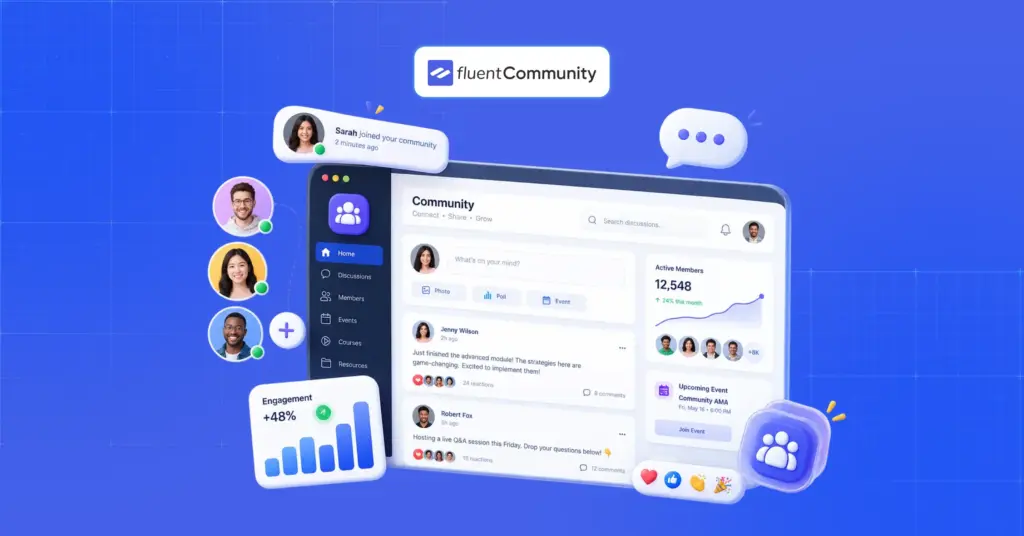
FluentCommunity runs on your WordPress site. Your community lives in your domain. Members sign up through your website, post discussions, interact in spaces (like groups within the community), and engage without ever leaving your ecosystem. It’s the closest thing to a Facebook Group in terms of social experience, feeds, comments, reactions, member profiles, notifications, but without Facebook’s downsides.
FluentCommunity is a complete community platform designed for businesses. Download now to create and manage your community.
Key Features
Spaces: Create multiple sub-communities within one installation. Each space works like a Facebook Group. Members can post, comment, and interact. You can make spaces public, private, or paid.
Activity Feed: A real-time feed similar to Facebook’s, but you control what appears and when.
Course and Content Integration: Native integration with FluentCRM and other WordPress tools means your community connects directly to your email list, course platform, and CRM.
Member Profiles: Full user profiles with activity history, bio, and social links.
Private Messaging: Members can message each other directly.
No ads, ever: Your members will never see a competitor’s ad inside your community. Why FluentCommunity Wins for WordPress Sites. If your business runs on WordPress, it covers 43% of all websites running your community on the same platform. It eliminates a major integration headache. Your existing users, your login system, your email list, and your community all live in one place.
The data ownership argument is the strongest case. With Facebook, your 10,000-member group belongs to Facebook. With FluentCommunity, those 10,000 members are in your WordPress database, connected to your CRM, and reachable by email even if your community went offline tomorrow.
For businesses that sell memberships, courses, or premium access, FluentCommunity integrates with payment plugins and membership tools natively. No revenue share. No platform fees per transaction.
Best for: WordPress site owners, course creators, agencies, plugin companies, and SaaS businesses with a WordPress audience.
Pricing: Free core plugin. Pro plan available with advanced features, and the annual price starts from $159
Circle: Best for Standalone Communities with a Clean UI
Circle is a standalone community platform built specifically for creators and businesses who want a professional community experience without building on WordPress. Circle launched in 2020 and has become the go-to option for creators and course builders who want a polished community without managing their own hosting. It lives at a Circle subdomain by default (though custom domains are available on paid plans).
Key Features
- Spaces for segmenting discussions (similar to channels or groups)
- Native live streaming and events
- Course hosting is built in on higher-tier plans
- Gamification with points and leaderboards
- Member directory
- Mobile apps for iOS and Android
Circle charges per member on its higher tiers. A community of 1,000 members costs significantly more than a community of 100. As your community grows, so does your monthly bill.
At scale, Circle’s pricing can exceed $500-1,000 per month. You also don’t fully own the data the same way you do on a self-hosted WordPress install. If Circle changes pricing, gets acquired, or shuts down, migrating your community is a major project.
Best for: Creators and solopreneurs who want a polished hosted solution and don’t want to manage WordPress.
Pricing: Starts at $89/month. Scales with membership count.
Mighty Networks: Best for Paid Membership Communities
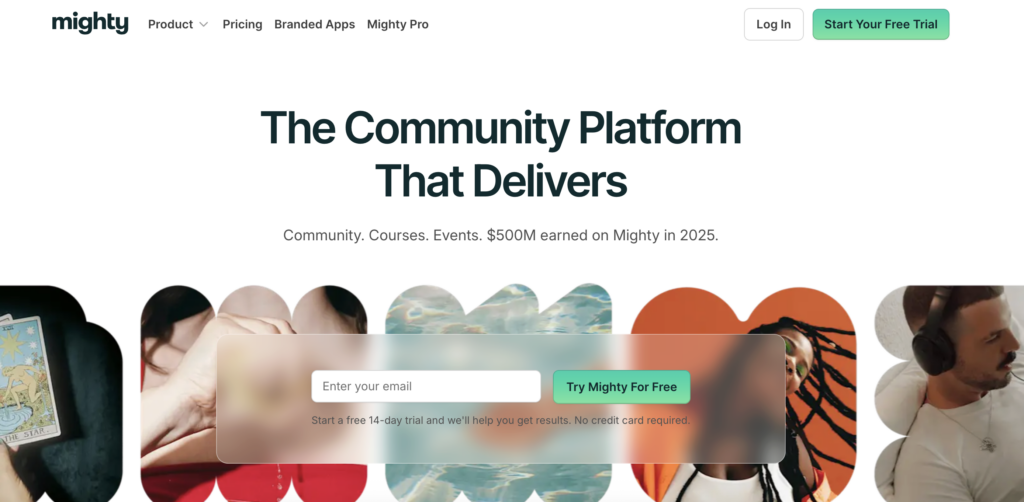
Mighty Networks is a hosted platform designed for building paid membership communities and online courses under one roof. Mighty Networks positions itself as an “all-in-one” platform for community, courses, and memberships. If you’re running a paid community with regular content, coaching programs, or online courses bundled in, Mighty Networks handles all of it in one place.
Key Features
- Community feeds, polls, and events
- Course builder with drip content
- Paid memberships and bundles
- Native mobile apps (white-labeled on higher plans)
- Host live events and video streams
- Built-in payment processing
Mighty Networks takes a transaction fee on payments unless you’re on the highest-tier plan. The fee ranges from 2-3% on lower plans. On a community generating $10,000/month in memberships, that’s $200-300 per month, leaving your pocket before Mighty Networks’ base subscription.
The community interface is functional but dated compared to newer platforms. Some users report that the mobile app experience is inconsistent.
Best for: Coaches, educators, and creators who are monetizing access to community + content and want everything in one hosted platform.
Pricing: Starts at $95/month. Mighty Pro (white-label apps) starts at $360/month.
Discord: Best for Real-Time, Engagement-Heavy Communities

Discord is a real-time messaging platform originally built for gamers but now used by millions of brand communities, developer communities, and creator fanbases. Discord is fundamentally a real-time chat tool. If your community is conversation-first, people are talking to each other constantly, sharing links, voice chatting, and playing games together. Discord is hard to beat. The free tier is genuinely generous.
Key Features
- Unlimited text channels organized into a server
- Voice and video channels with screen sharing
- Roles and permissions for tiered access
- Threads for organizing conversations
- Stage channels for live audio broadcasts
- Bots for automation, moderation, and gamification
- Free for unlimited members
Discord’s archive problem is real. Conversations move fast, and older content disappears into the scroll. It’s not searchable in the same way a forum is. A new member joining your Discord in 2025 can’t easily browse discussions from 2023.
Discord also doesn’t offer email capture by default. Your members exist inside Discord’s ecosystem. If they leave Discord or the platform goes down, you lose contact with them. For businesses that need structured, indexed discussions, the kind that bring in organic traffic and serve future members, Discord is a poor fit.
Best for: Developer communities, gaming communities, creator fanbases that value real-time chat over structured discussion.
Pricing: Free. Discord Nitro ($9.99/month) adds cosmetic features for users.
Bettermode: Best for B2B SaaS Communities
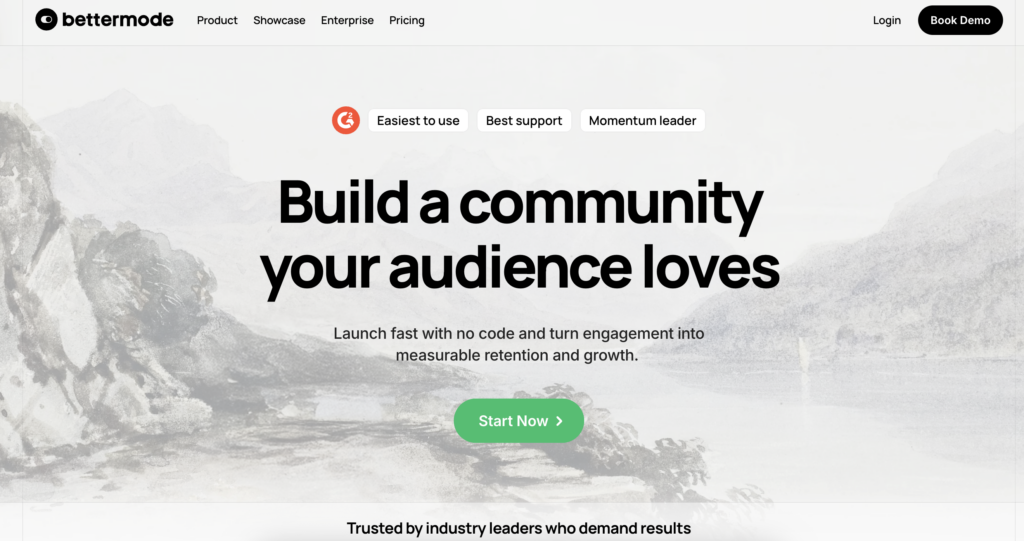
Bettermode is a community platform aimed at SaaS companies that want to build customer communities, support forums, and product feedback hubs. Bettermode rebranded from Tribe in 2022 and repositioned itself for B2B use cases, customer success communities, support forums, product feedback boards, and user groups. It integrates well with tools like Intercom, Zendesk, and HubSpot.
Key Features
- Highly customizable community spaces
- API-first architecture for deep product integration
- Custom widgets for embedding a community inside a SaaS product
- Moderation tools and spam filters
- SSO support for existing user bases
- Analytics dashboard
Bettermode’s pricing is enterprise-oriented. The free tier is limited to 100 members, which makes it impractical for growing communities. The interface has a steeper learning curve than more consumer-focused platforms. For WordPress-based businesses, the integration story is weaker than native WordPress solutions.
Best for: B2B SaaS companies building customer communities, support hubs, or product feedback boards tightly integrated with their existing stack.
Pricing: Free up to 100 members. Paid plans start at $499/month. Enterprise pricing on request.
Quick Comparison: Facebook Group Alternatives at a Glance
| Platform | Hosting | Data Ownership | Free Plan | Best For |
| FluentCommunity | Self-hosted (WordPress) | Full | Yes | WordPress businesses |
| Circle | Cloud | Partial | No | Creators and coaches |
| Mighty Networks | Cloud | Partial | No | Paid membership communities |
| Discord | Cloud | None | Yes | Real-time chat communities |
| Bettermode | Cloud | Partial | Limited | B2B SaaS customer communities |
Which Facebook Group Alternative Should You Choose?
If you want a solution that can adapt to almost any use case, FluentCommunity stands out as the most flexible option. Built for WordPress, it lets you run everything. From community discussions and courses to memberships and real-time engagement, all in one place. Your community lives on your own domain, integrates with your CRM and marketing stack, and gives you full ownership of your data. Instead of juggling multiple tools (and multiple subscriptions), you get a unified system that scales with your business.
If you’re a creator without a WordPress site and prefer a fully hosted solution, platforms like Circle or Mighty Networks can be good starting points. Circle works well for community-first experiences, while Mighty Networks is more suited for combining courses with community features.
For highly active, real-time conversations, Discord offers one of the best chat experiences and is free to use. However, it’s best paired with an email list or external system so you’re not fully dependent on the platform.
If you run a B2B SaaS product and need deeper integrations, Bettermode is worth exploring, especially for features like SSO and API access that connect your community with your existing customer ecosystem.
In short, if you’re looking for an all-in-one, scalable, and fully owned solution, FluentCommunity gives you the most control without the limitations of hosted platforms.
Conclusion
Facebook Groups made starting a community easy. But easy isn’t the same as good. Declining reach, zero data ownership, and competitor ads in your feed are real costs that compound over time.
The five platforms above all give you more control than Facebook. For WordPress businesses, FluentCommunity is the strongest option. You get a Facebook-like social experience, complete data ownership, and no platform fees.
For everyone else, Circle, Mighty Networks, Discord, and Bettermode each cover specific use cases well. The best time to move your community off Facebook was two years ago. The second-best time is now.

Prema Anjum
My full name is Anzuman Ara Chowdhury. But people know me as Prema Anjum. I’m a Digital Marketer by profession, a WordPress community contributor, and a travel enthusiast by heart.

Add your first comment to this post