

Future of Online Communities in the AI Era: Why Small Businesses Should Care

Table of Content
Subscribe To Get
WordPress Guides, Tips, and Tutorials


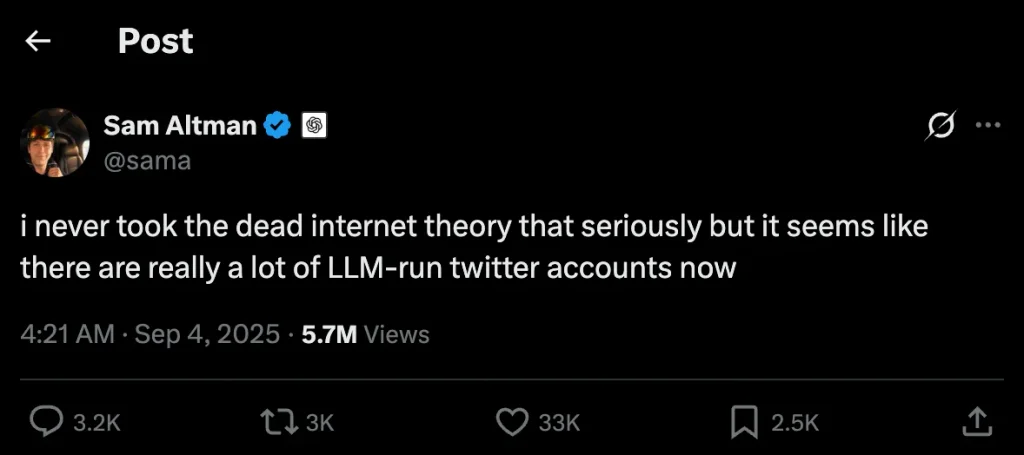
In September 2025, OpenAI CEO Sam Altman posted that there are “really a lot of LLM-run twitter accounts now.” When the person behind ChatGPT says the web feels less human, small businesses should listen.
Here’s what the data says about the future of online communities, and why an owned community may be your smartest move.
Key Takeaways
- AI answers now satisfy many searches before anyone clicks a link
- Machine-made content and bot traffic make verified human spaces more valuable
- Google and AI engines both reward first-hand conversation, the core output of a community
- Small businesses can own that conversation on their own site instead of renting it
The Future of Online Communities, in Plain Terms
The future of online communities is smaller, private, and human-first. Brands and creators will host owned spaces where real members talk, learn, and buy, instead of chasing reach on crowded social feeds. AI will handle the background work. People will supply the trust that AI can’t fake.
That’s the short answer. The longer one comes from three forces that collided between 2023 and 2026. AI took over a big slice of search. Machine-made content flooded the web. And people got lonelier and more skeptical at the same time.
Honestly, this isn’t a story about AI killing communities. It’s closer to the opposite. When almost anything online can be generated, the things that can’t be generated start to carry a premium: a real person’s experience, or a reply from someone who remembers your name. Let’s look at the evidence.
How AI Changed the Internet in Just 3 Years
Here are some of the notable changes AI made over the course of few years:
Search Turned Into an Answer Engine
Back in February 2024, Gartner predicted that traditional search engine volume would drop 25% by 2026 as AI chatbots and virtual agents took over queries. Gartner analyst Alan Antin said generative AI tools are “becoming substitute answer engines.”
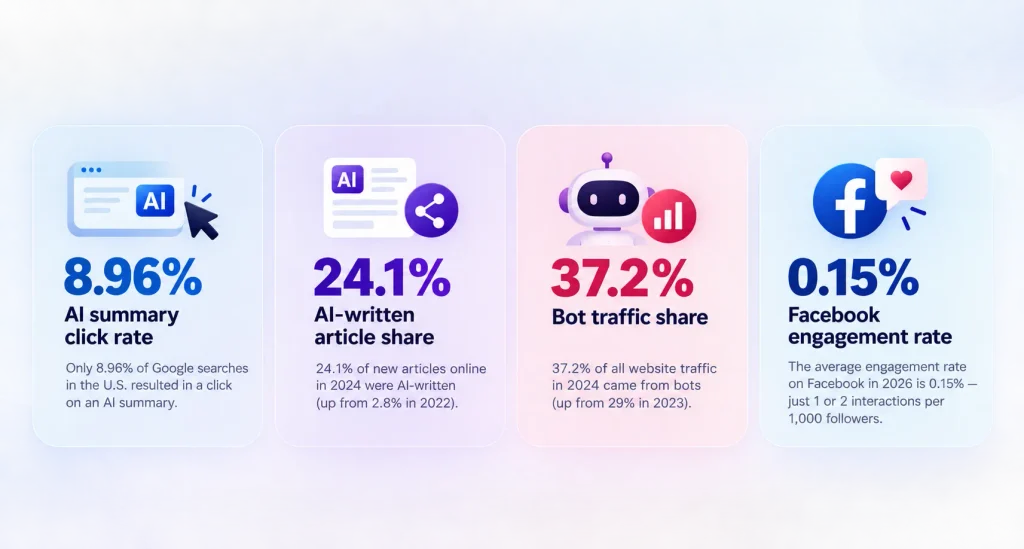
The behavior data backs that up. A Pew Research Center study tracked 68,879 real Google searches from 900 U.S. adults in March 2025. When an AI summary appeared, people clicked a traditional result in just 8% of visits. Without a summary, they clicked in 15%.
Links inside the AI summary itself got clicked in only 1% of visits. So what does that mean for a small business? If your growth plan depends on someone clicking a blue link, that plan just got thinner. More answers now end on Google’s own page or inside a chat window.
The Web Filled Up With Machine-Made Words
SEO firm Graphite analyzed 65,000 English-language articles from the Common Crawl archive. As TechRadar reported, AI-generated articles passed half of all newly published web articles in November 2024. Within roughly a year of ChatGPT’s launch, AI authorship had climbed from almost nothing to nearly 40%.
Here’s the twist most coverage skipped. The same study found that most of those AI articles rarely appear in Google results or ChatGPT answers. Volume went up, but visibility didn’t follow. That’s a useful hint about what search engines and answer engines actually want to show people.
Bots took over the traffic side too. The 2025 Imperva Bad Bot Report found automated traffic made up 51% of all web traffic in 2024, passing human activity for the first time in a decade. One caveat: this figure comes from a single security vendor, so treat the exact number as directional.
Trust Took a Measurable Hit
Ad network Raptive surveyed 3,000 U.S. adults on how they rate online content. When readers suspected a piece was AI-generated, they found it 48% less trustworthy and 57% less authentic. Their emotional connection dropped 60%. The kicker? Those penalties applied whether or not AI actually wrote it.
In simple terms, suspicion alone now costs you. Readers have learned to scan for robotic phrasing and generic advice. Once they spot it, or think they spot it, they discount everything around it, including your brand and your offer.
Social Reach Kept Shrinking
Meanwhile, the “free” channel most small businesses relied on got quieter. Socialinsider’s 2026 benchmarks, built from 25 million Facebook posts across more than 130,000 business pages, put the average engagement rate at 0.15%. That’s one or two interactions for every 1,000 followers.
Think of it like renting a billboard on a road the landlord keeps rerouting. You still pay in time and content. You just can’t control who drives past, or whether anyone drives past at all.
Why Human Conversation Is Now the Internet’s Scarce Resource
Basic economics says that when something becomes abundant, it gets cheap, and whatever stays rare gets more valuable. Text is now abundant. Verified human experience isn’t. That simple shift explains a lot of what Google and the AI companies have done since 2022.
Google added a “Discussions and forums” feature to results in 2022 after users asked for more first-hand advice, as Search Engine Journal covered. In 2023, it followed with ranking work aimed at “hidden gems,” meaning personal insights buried in forums, social posts, and small blogs, according to Search Engine Roundtable.
AI answer engines lean the same way. Data from analytics platform Profound, reported by Press Gazette, showed Reddit as the most-cited domain across AI models in the three months ending June 30, 2025. Among the top ten sources, it was cited twice as often as Wikipedia.
Now look at which Reddit posts get cited. A Semrush study of 248,000 cited Reddit posts found most had fewer than 20 upvotes and 20 comments. AI isn’t hunting for viral threads. It wants specific, helpful answers from people who have done the thing. That’s exactly what a good niche community produces every week.
People Want More Connection, Not Less
The human side matters too. Gallup’s wellbeing research finds that about one in five Americans experience significant loneliness on a daily basis. People aren’t only searching for answers. Many are also searching for someone to talk to, and for a place where they feel known.
Big tech has noticed. On the Dwarkesh Podcast in April 2025, Meta CEO Mark Zuckerberg suggested AI companions could help close the gap between how many friends people have and how many they want. University of Kansas psychologist Omri Gillath pushed back with one sharp line: “AI cannot introduce you to their network.”
That sentence is the whole case for community in seven words. A chatbot can answer your customer’s question. It can’t introduce that customer to another customer who solved the same problem last month. Communities do that, and it’s the part of the internet AI can’t automate away.
6 Shifts Shaping the Future of Online Communities
Put those forces together and a clear picture forms. These are the six shifts shaping the future of online communities, and what each one means for a small team with limited time.
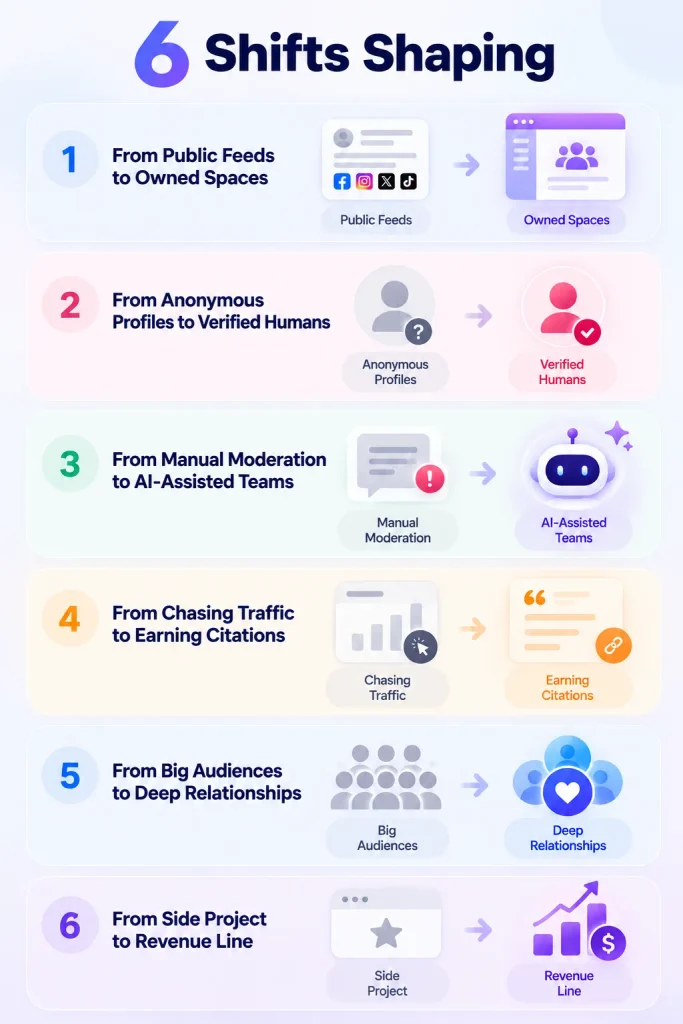
1. From Public Feeds to Owned Spaces
For years, “community” meant a Facebook Group or a Discord server. Those still work for some people, but the business owns none of it. The platform owns the member list, the algorithm, and the rules. When those change, your community changes with them, whether you like it or not.
Kevin Kelly’s well-known essay 1,000 True Fans made a point that ages better every year. For the model to work, he wrote, “you must have a direct relationship with your fans.” That means your message reaches them without a middleman deciding who sees what. Owned spaces on your own domain deliver that.
2. From Anonymous Profiles to Verified Humans
As bots get better at posting, “Is this a real person?” becomes a product question, not a philosophy question. Expect future communities to lean on visible trust signals: real profiles, invite-only spaces, member verification, purchase-linked access, and active human moderation.
This actually favors small communities. A 300-member space where the founder knows half the names is far harder to fake than a public feed with millions of accounts. In the AI era, smaller is a defense, not a weakness.
3. From Manual Moderation to AI-Assisted Teams
Community managers already use AI heavily. The 2026 CMX Community Industry Report found that 93% of community professionals now use AI tools, up from 81% the year before. AI went from experiment to everyday tool in about twelve months.
The smarter teams draw a line, though. At CMX’s 2025 Circuit events, community leaders stressed transparency and described guardrails that keep GPT-generated replies out of key discussions. A good rule of thumb: let AI work backstage and keep humans onstage.
4. From Chasing Traffic to Earning Citations
Classic SEO asked, “How do I get the click?” The AI era adds a second question: “How do I become the source?” Public community threads, full of real questions and experienced answers, are exactly the format that answer engines like to quote.
That doesn’t mean making everything public. Paid and sensitive spaces should stay private. But one or two open spaces, such as a public Q&A or help forum, can turn member knowledge into a long-term discovery asset that lives on your own site.
5. From Big Audiences to Deep Relationships
Kelly’s math still holds up. If 1,000 true fans each bring you $100 a year in profit, that’s $100,000. You don’t need a million followers. You need a few hundred people who genuinely care, plus a place where they can find each other.
Marketer Seth Godin captures the pull of belonging in his book This Is Marketing with one simple phrase: “People like us do things like this.” Communities are where “people like us” becomes visible. That shared identity drives repeat purchases better than another ad ever could.
6. From Side Project to Revenue Line
The last shift is financial. Communities are moving from “nice to have” to an actual product. Many small businesses now pair a free space for discovery with a paid inner circle, course, or membership for their most engaged customers. The community becomes the marketing channel and the thing people pay for.
Why Small Businesses Should Care More Than Big Brands
Big brands can outspend everyone on ads and content volume. AI just made generic content nearly free, which erases much of that advantage. What small businesses still have is harder to copy: founder access, specific know-how, and customers who would happily help each other.
Owned Attention Beats Rented Reach
When you post to a social page, the algorithm decides who sees it. At 0.15% average engagement on Facebook, even a loyal following barely registers. In an owned community, members opted in, chose your topic, and get notified about new posts on your site. You decide what they see.
It also protects you from platform risk. If a social network changes its rules, bans an account by mistake, or starts charging for reach, your member list, your posts, and your history stay exactly where they are. That stability is hard to put a price on.
Your Customers’ Questions Become Your Best Content
Every question a customer asks in a community is a content brief written by your market. Answer it once, in the open, and it keeps helping the next person. Over time, those threads become an FAQ, a support library, and the first-hand material that search engines and AI tools look for.
Picture a small skincare brand. A customer asks how to layer two serums without irritation. Another customer shares her routine, and the founder adds a tip. That thread now answers the question better than any product page could, and it uses the exact words real buyers use.
Trust Compounds Over Time
The financial case isn’t new. In a Harvard Business Review article, researchers René Algesheimer and Paul Dholakia described a field experiment with eBay customers who were randomly invited to join its communities. Participants, including people who only read posts, bid more often and spent up to 54% more than a control group.
It’s an older study from a giant marketplace, so treat the exact figure as a signal, not a promise. Still, the direction matches what community builders see today. People who feel part of something stay longer, buy more, and bring their friends along.
Where AI Helps a Community and Where It Hurts
AI makes a great assistant and a poor substitute. Here’s how we’d split the work between AI and the people running your community:
| Community task | Let AI help | Keep it human |
| Spam and bot filtering | Flag suspicious posts and signups | Final call on bans and appeals |
| Weekly digests | Draft a summary of top threads | Add the founder’s take and highlights |
| Repeat questions | Point members to existing threads | Answer anything new or nuanced |
| Onboarding | Draft welcome templates | A personal hello from a real team member |
| Reports and conflict | Sort and prioritize the queue | Every moderation decision |
| Emotional or sensitive posts | Flagging only | A thoughtful human reply |
What Not to Do With AI in Your Community
These mistakes will age badly as members get better at spotting automation:
- Don’t create fake AI members to make the space look busy
- Don’t auto-reply to posts where someone is struggling or upset
- Don’t hide AI use; tell members where and how you use it
- Don’t publish AI-written founder posts without rewriting them in your voice
- Don’t buy members or engagement, since empty growth kills trust fast
- Don’t lock every thread behind a paywall if you want to be found
How to Build a Future-Ready Community on Your Own Site
Here’s the practical part. Follow these steps in order, since each one builds on the last. We’ll use FluentCommunity, a WordPress community and LMS plugin, as the worked example because it runs on your own site. Other tools exist, but the principles stay the same.
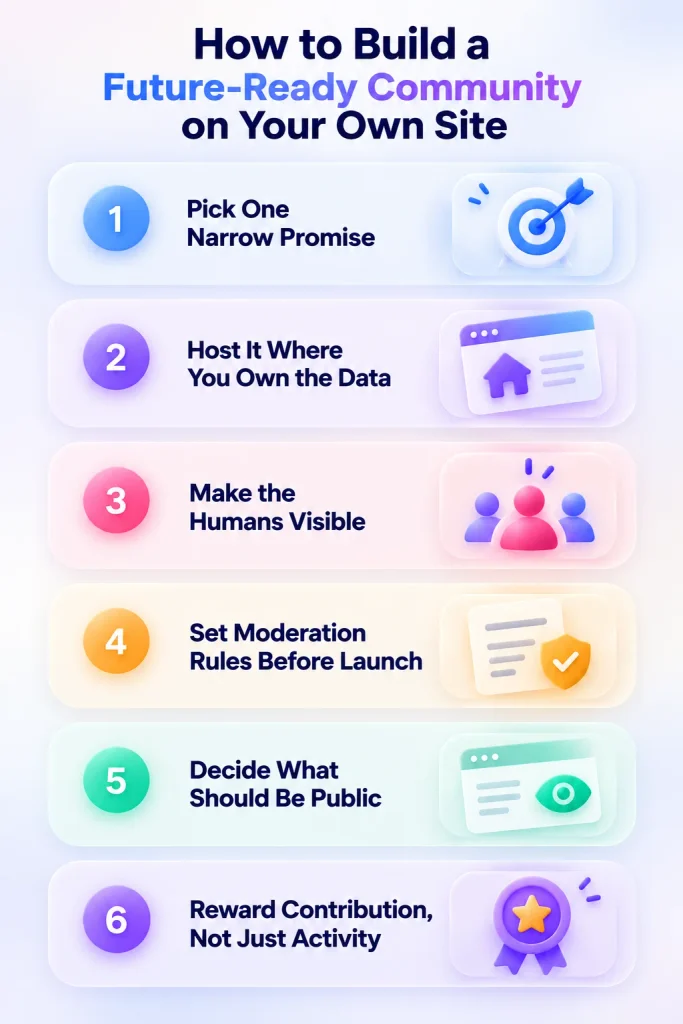
Step 1: Pick One Narrow Promise
Start with a specific outcome, not a vague topic. “A community for home bakers” is broad. “Help home bakers fix their first sourdough loaf in 30 days” gives people a reason to join today. A narrow promise also makes moderation, content planning, and onboarding much easier to manage.
Step 2: Host It Where You Own the Data
This step matters most in the AI era. With FluentCommunity, every post, member, and file lives in your own WordPress database, with no export fees. Pricing is a flat fee per site, not per member, so growth doesn’t raise your bill. You can compare current plans on the pricing page.
One reviewer, David McCan, called the plugin a good choice for product owners who want “a user community off of social media.” That’s the exact shift this article is about, and it’s a decision you can make this month.
Step 3: Make the Humans Visible
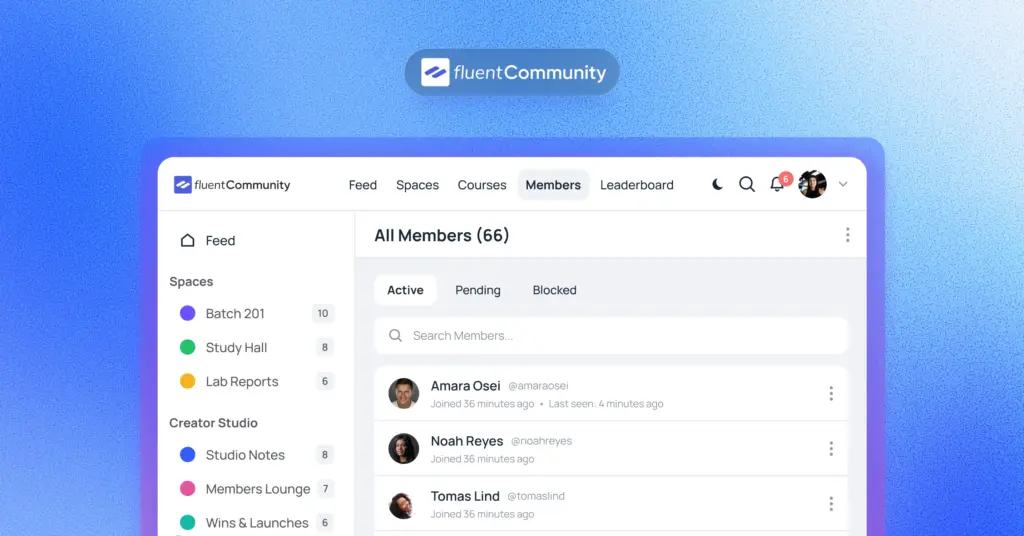
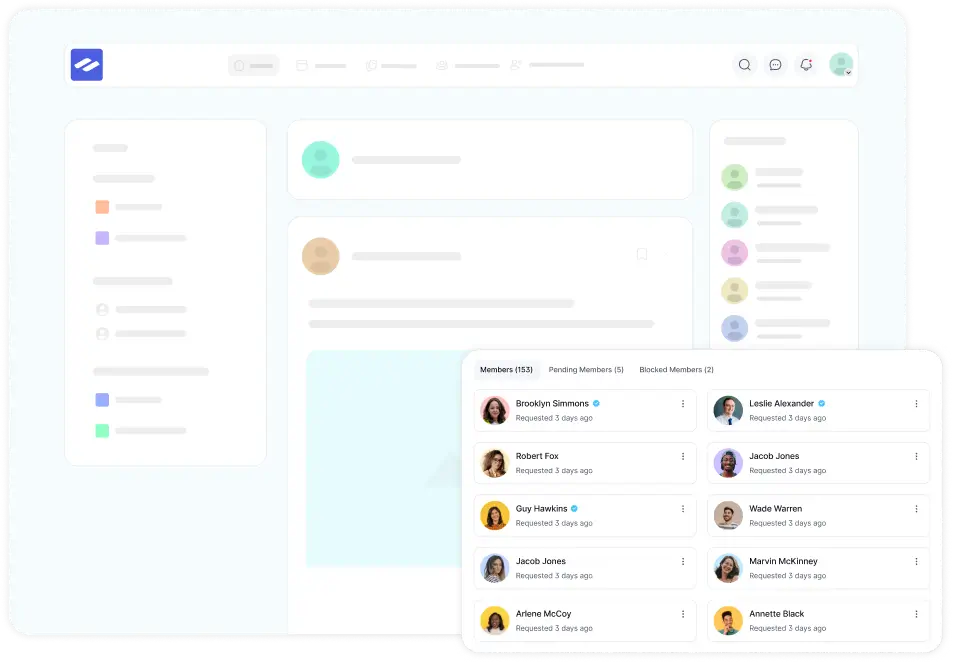
In a bot-heavy internet, members want proof that the people around them are real. The plugin supports rich profiles with avatars, cover photos, bios, social links, and custom fields like role or location. Verification badges let you mark experts and paying members, so trust shows at a glance.
Step 4: Set Moderation Rules Before Launch
Write three to five clear rules, then back them up with tools. The plugin includes a moderation queue where members flag content, first-post approval with auto-flagging, and spam protection. Manager roles let moderators handle the queue without full WordPress admin access.
Step 5: Decide What Should Be Public
Spaces can be public, private, or secret, set one by one. Keep paid and sensitive spaces closed. Then open one or two spaces, like a public Q&A, where good answers can be found. FluentCommunity adds public community content to your XML sitemap so search engines can index it.
Step 6: Reward Contribution, Not Just Activity
Gamification works best when it rewards helpfulness. The plugin ships with points, levels, badges, and a leaderboard. Pair those with polls and scheduled posts so the space stays active during slow weeks. Then check the analytics for top members, top commenters, and your most popular spaces.
Step 7: Add a Paid Layer When Members Ask for More
Don’t start with a paywall. Start with value, then listen. When members ask for deeper help, design a custom lock screen and sell access to a space through FluentCart or Paymattic. Members are added or removed as payments succeed or lapse. Courses are built in through the LMS features.
A free version of the plugin is available on WordPress.org, and the Free vs Pro comparison shows which features need a license. If you already use FluentCRM, you can connect it to handle email follow-ups with your members.
The Bottom Line for Small Businesses
The AI era didn’t make communities obsolete. It made them one of the few marketing assets that get stronger as the rest of the web gets noisier. Every month you wait, more of your customers’ questions get answered on someone else’s platform, or in a summary that never mentions you.
So start small this week. Choose one narrow promise, invite your 20 best customers, and answer their questions in a space you own. Watch which threads people come back to, then build from there.
If you want that space on your own WordPress site, with your data, your branding, and one flat price, explore FluentCommunity’s features and set up your first space today. Your community doesn’t need to be big. It needs to be yours.
Frequently Asked Questions
Will AI Replace Online Communities?
No. AI can answer questions, but it can’t create belonging or introduce people to each other. As AI-generated content grows, verified human spaces become more valuable, not less. Expect AI to handle more behind-the-scenes work, like spam filtering and summaries, while people stay at the center.
Are Online Communities Still Worth It for Small Businesses?
Yes, arguably more than before. AI summaries reduce clicks to websites, and organic social engagement keeps falling. An owned community gives a small business direct access to its customers, a steady source of first-hand content, and a trust signal that generic AI content can’t copy.
What Is the Difference Between a Social Media Group and an Owned Community?
A social media group lives on a platform that controls the algorithm, the rules, and the member data. An owned community runs on your own website, so you control access, branding, data, and monetization. If a social platform changes its policies, an owned community keeps working.
How Do Online Communities Help With AI Search Visibility?
Answer engines frequently cite first-hand discussions. Studies show Reddit is among the most-cited sources in AI answers, often for small and specific threads. Public Q&A spaces in your own community can produce the same kind of experienced, specific content, but on your own domain.
How Big Does a Community Need to Be?
Smaller than most people think. Kevin Kelly’s 1,000 True Fans model shows a creator can earn a living with about 1,000 committed supporters. For a small business, a few hundred active members can drive repeat sales, referrals, and honest product feedback.
Should I Use AI to Moderate My Community?
Use AI to flag spam, sort reports, and summarize activity. Keep final moderation decisions and sensitive replies with a person. Be open with members about where AI is used, because hidden automation tends to damage trust once people notice it.

Ashik Elahi
Ashik Elahi is a seasoned Digital Marketing Strategist with a passion for Content Marketing. He believes in the power of storytelling and crafting valuable content that resonates with readers.
Add your first comment to this post